How to Use a CPM Calculator
A CPM calculator automates the formula and eliminates manual calculations.
Typical steps include:
- Enter the total campaign cost
- Enter the number of impressions
- Click calculate
- The calculator returns the CPM value instantly
Many calculators also allow reverse calculations, such as:
- estimating impressions from CPM and budget
- estimating campaign cost from CPM and impressions.
These functions help marketers plan advertising campaigns more efficiently.
CPM Calculator: How to Calculate Cost Per Mille in Digital Advertising
Online advertising runs on measurable metrics. Marketers track impressions, clicks, conversions, and revenue to determine whether a campaign is profitable. Among these metrics, CPM (Cost Per Mille) remains one of the most widely used pricing models.
CPM measures how much an advertiser pays for 1,000 ad impressions. It is common in display advertising, social media campaigns, programmatic advertising, and video ads.
A CPM calculator simplifies the process of estimating advertising costs or evaluating campaign performance. Instead of calculating values manually, marketers can quickly determine CPM, impressions, or campaign cost.
This guide explains:
- what CPM means in advertising
- how to calculate CPM step by step
- how a CPM calculator works
- CPM benchmarks by industry and country
- how CPM compares with other advertising metrics
- factors that influence CPM in digital campaigns.
What Is CPM in Advertising?
CPM stands for Cost Per Mille, where mille means one thousand.
In digital advertising, CPM represents the price paid for one thousand impressions.
An impression occurs whenever an advertisement loads on a webpage, mobile app, or video platform.
CPM pricing appears frequently in advertising platforms such as:
- Google Ads
- Meta Ads Manager
- Amazon DSP
This pricing model is most common in campaigns focused on visibility and reach rather than immediate clicks.
CPM Formula
The CPM formula converts the total campaign cost into the price for 1,000 impressions.

CPM = (Total Cost ÷ Total Impressions) × 1000
Example:
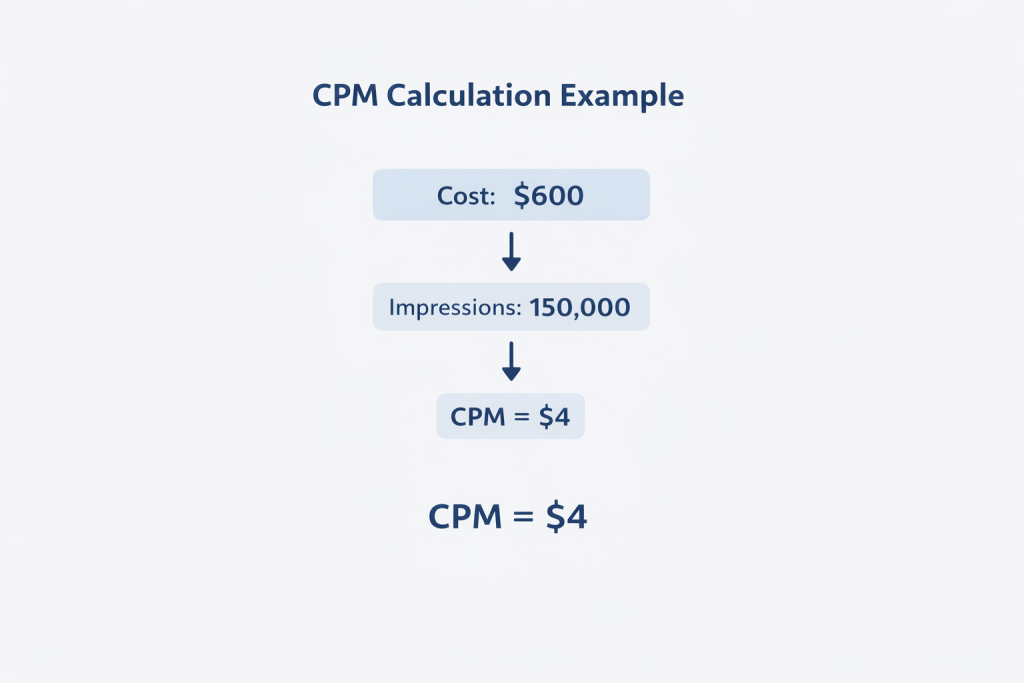
Campaign cost: $600
Total impressions: 150,000
Calculation:
600 ÷ 150000 = 0.004
0.004 × 1000 = $4 CPM
This means the advertiser paid four dollars for every thousand impressions.
Example CPM Calculation
Suppose a campaign runs on Meta Ads Manager.
Campaign statistics:
Budget: $1,200
Impressions: 240,000
Calculation:
CPM = (1200 ÷ 240000) × 1000
CPM = $5
The campaign costs five dollars per thousand impressions.
How to Calculate CPM Step by Step
Marketers often calculate CPM during campaign analysis.
Step 1: Determine total advertising cost
Example:
Campaign budget: $2,000
Platform: Google Ads
Step 2: Find the number of impressions
Example:
Impressions generated: 500,000
Step 3: Apply the formula
CPM = (Cost ÷ Impressions) × 1000
Calculation:
(2000 ÷ 500000) × 1000 = $4 CPM
Estimating Campaign Cost from CPM
Sometimes marketers know the CPM and need to estimate campaign cost.
Example:
Target impressions: 300,000
CPM: $6
Calculation:
300000 ÷ 1000 × 6 = $1,800
Estimating Impressions from CPM and Budget
Example:
Budget: $2,500
CPM: $5
Calculation:
Impressions = (Budget ÷ CPM) × 1000
(2500 ÷ 5) × 1000 = 500,000 impressions
This estimate helps marketers plan campaign reach.
CPM by Ad Format
Different advertising formats often produce different CPM ranges because engagement and inventory value vary.
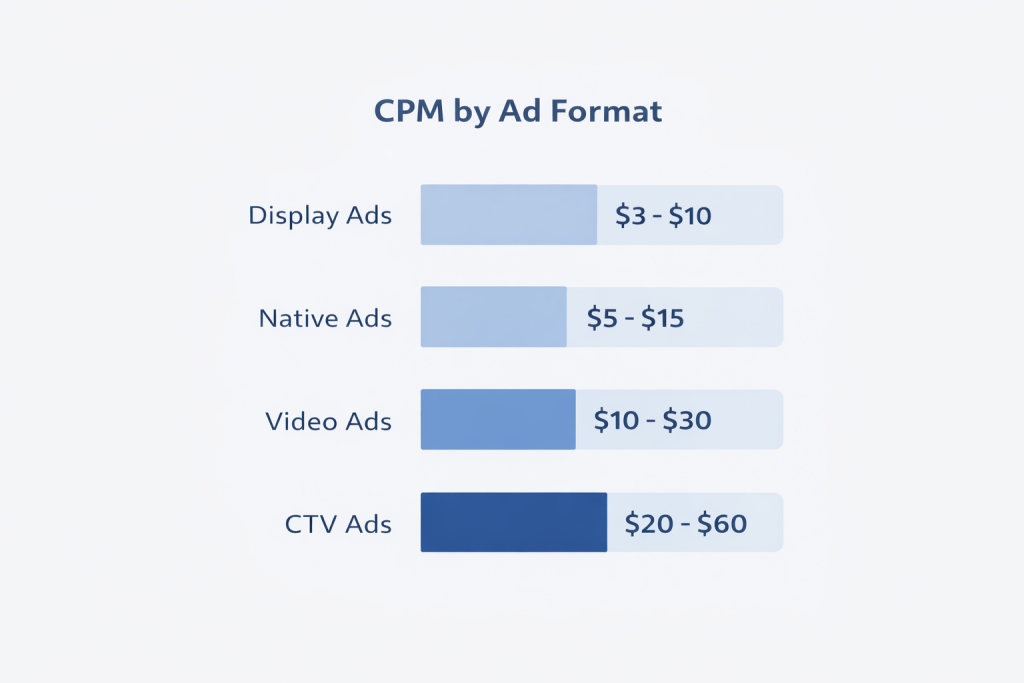
Typical CPM benchmarks by format:
| Ad Format | Typical CPM Range |
|---|---|
| Display Ads | $3 – $10 |
| Native Ads | $5 – $15 |
| Video Ads | $10 – $30 |
| Social Media Ads | $5 – $15 |
| Programmatic Premium | $15 – $40 |
| Connected TV (CTV) | $20 – $60 |
Video and connected TV advertising often generate higher CPM because viewers spend more time engaging with the content.
Platforms like YouTube Ads typically command higher CPM rates than standard banner advertising.
CPM vs Other Advertising Metrics
Digital advertising includes several pricing and performance metrics. Understanding their differences helps marketers select the right campaign strategy.
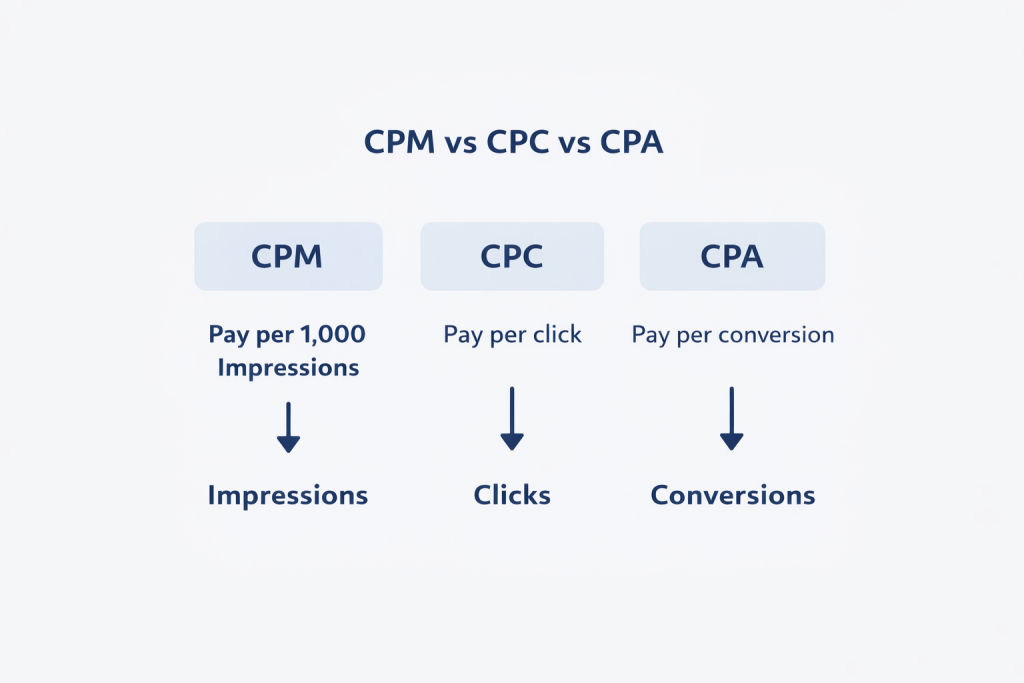
| Metric | Meaning | Primary Use |
|---|---|---|
| CPM | Cost per 1,000 impressions | Brand awareness campaigns |
| CPC | Cost per click | Traffic acquisition |
| CPA | Cost per acquisition | Conversion campaigns |
| CTR | Click-through rate | Engagement measurement |
| RPM | Revenue per 1,000 impressions | Publisher revenue |
CPM vs CPC
CPM charges advertisers for impressions, while CPC charges only when users click the advertisement.
CPM vs CPA
CPA focuses on measurable outcomes such as purchases or sign-ups.
CPM vs RPM
RPM measures revenue per thousand impressions and is usually used by publishers rather than advertisers.
CPM Benchmarks by Industry
CPM varies significantly between industries because customer acquisition value differs.
Typical ranges:
| Industry | Typical CPM |
|---|---|
| E-commerce | $5 – $12 |
| SaaS / Software | $12 – $25 |
| Finance & Insurance | $15 – $40 |
| Healthcare | $10 – $30 |
| Education | $6 – $18 |
| Travel | $8 – $20 |
| Real Estate | $10 – $28 |
| Gaming | $4 – $10 |
| Mobile Apps | $5 – $14 |
| Luxury Products | $20 – $60 |
Industries like finance or SaaS tend to have higher CPM because advertisers compete strongly for valuable audiences.
CPM Benchmarks by Country
Advertising costs also vary widely between countries.
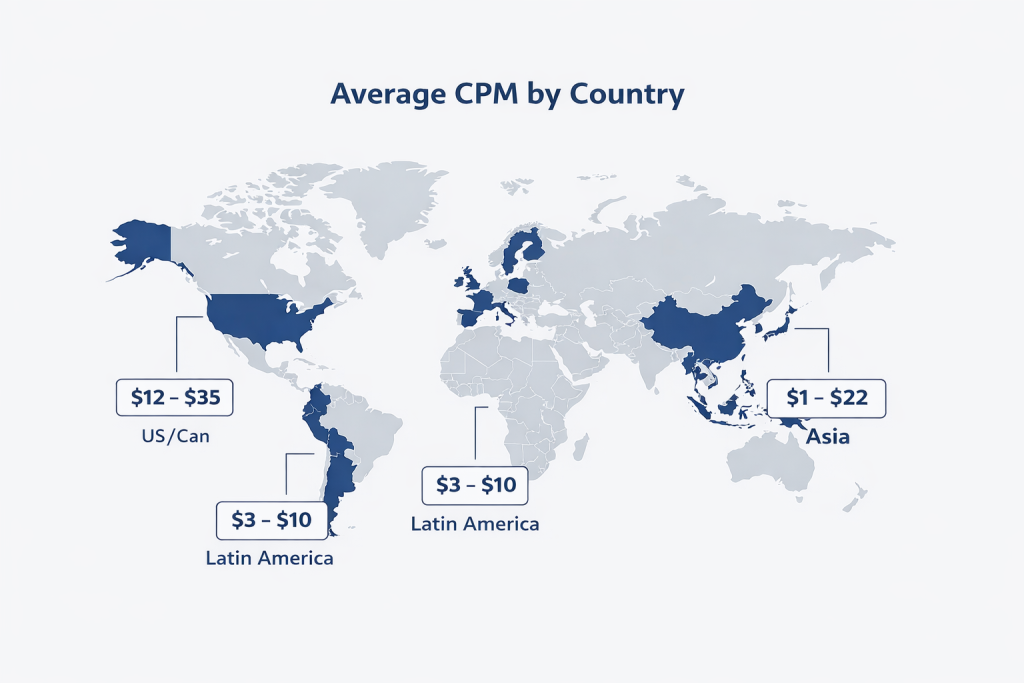
| Country | Typical CPM |
|---|---|
| United States | $12 – $35 |
| Canada | $10 – $28 |
| United Kingdom | $10 – $30 |
| Germany | $9 – $25 |
| Australia | $9 – $24 |
| France | $8 – $20 |
| Netherlands | $8 – $22 |
| Sweden | $7 – $20 |
| Japan | $8 – $22 |
| South Korea | $7 – $18 |
| Singapore | $10 – $26 |
| Brazil | $4 – $12 |
| Mexico | $3 – $10 |
| Poland | $3 – $9 |
| India | $1 – $5 |
Lower-CPM markets often deliver more impressions for the same advertising budget.
Factors Affecting CPM
Several factors influence CPM in digital advertising.
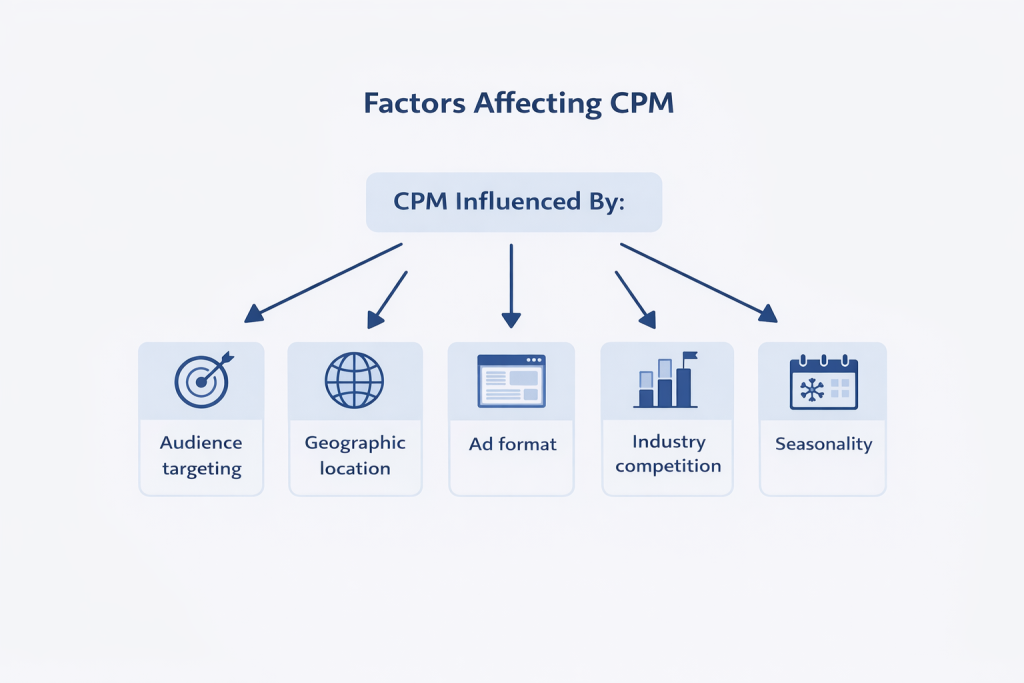
Audience Targeting
Highly specific audiences often increase CPM because more advertisers compete for that audience.
Example:
Targeting “software developers in San Francisco” usually costs more than targeting a broad demographic group.
Geographic Location
Advertising markets differ in purchasing power and competition.
Campaigns targeting the United States or Western Europe usually produce higher CPM than campaigns targeting emerging markets.
Ad Format
Video ads, interactive ads, and connected TV advertising generally have higher CPM than static banner ads.
Industry Competition
Some industries invest heavily in digital advertising. Finance, insurance, and software sectors often bid aggressively for ad inventory.
Seasonality
Advertising demand changes during the year. CPM often increases during high-spending periods such as the holiday shopping season.
CPM in Programmatic Advertising
Programmatic advertising uses automated auctions to determine CPM.
Platforms such as:
- Google Ad Manager
- The Trade Desk
enable advertisers to bid for impressions in real time.
When a user loads a webpage, advertisers compete in an automated auction. The highest bid determines the CPM price for that impression.
When CPM Is the Best Pricing Model
CPM works best in campaigns focused on visibility rather than direct conversions.
Typical CPM campaigns include:
- product launches
- brand awareness campaigns
- entertainment marketing campaigns
- large-scale media buys.
Companies often use CPM campaigns at the beginning of marketing funnels to reach large audiences.
Use Our Free CPM Calculator
Calculating CPM manually is simple, but marketers often perform these calculations repeatedly during campaign planning.
A CPM calculator allows you to:
- estimate advertising costs
- calculate impressions from a budget
- compare advertising platforms
- analyze campaign performance.
Enter your campaign cost and impressions into the calculator to determine your CPM instantly.
Frequently Asked Questions
What does CPM mean in advertising?
CPM stands for Cost Per Mille and represents the price advertisers pay for one thousand impressions.
How do you calculate CPM?
CPM is calculated using the formula:
CPM = (Total Cost ÷ Total Impressions) × 1000.
What is a good CPM rate?
Typical CPM ranges from $3 to $15 for display advertising, though competitive industries may exceed $20.
Why is my CPM high?
High CPM may result from narrow audience targeting, strong advertiser competition, premium placements, or seasonal demand increases.
What is the difference between CPM and CPC?
CPM charges advertisers for impressions, while CPC charges only when users click the advertisement.